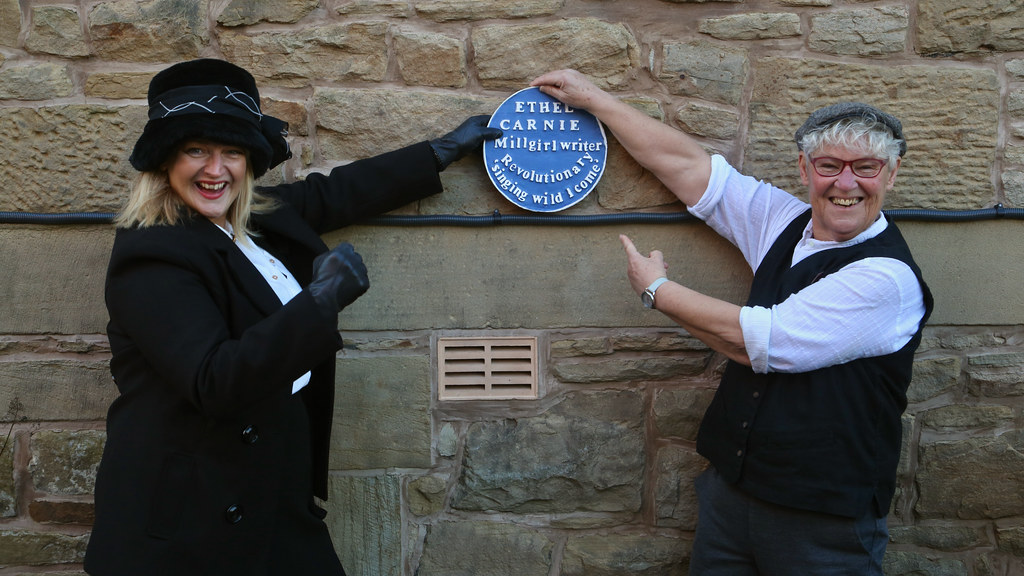
Alternative Blue Plaque Reclaims the Mill Poetess
Cause UK (Cause UK) FOR IMMEDIATE RELEASE
10 MARCH 2022
An alternative blue plaque reclaimed the mill poetess Ethel Carnie Holdsworth this week.
On 8 March, 18 volunteers and academics wearing Victorian hats and sashes set off on a vintage bus to travel to key Lancashire locations in Ethel’s life.
Activist, poet, journalist and author Ethel Carnie Holdsworth (1886-1962), is believed to be the first working-class woman in Britain to publish a novel.
Pendle Radicals, a research and creative project led by Mid Pennine Arts, explores stories of Pendle Hill’s radical thinkers. They contacted the art collective Rosie’s Plaques to help identify uncelebrated female radicals, deserving of a plaque.
Rosie’s Plaques began the alternative plaques after finding out that of the 4,500 heritage blue plaques in the UK, less than 12% celebrate women.
An alternative Blue Plaque travelled on the bus to key places featured in Ethel’s life.
Janet Swan, Project Lead at Pendle Radicals said: “The alternative plaque is well deserved. She was remarkable as a writer, a woman and an activist. It’s time her name is celebrated and known more widely.”
The vintage bus set off from Glebe Street Great Harwood where Ethel went to school, and is the site of the mill where Ethel worked as a half timer.
The bus then went to locations where Ethel grew up and had formative experiences, including the Co-operative Reading Rooms, where she acquired the love of reading.
The journey ended at the house at Slack Top, Heptonstall, where Ethel lived while producing The Clear Light - the anti-fascist newspaper that even in the 1920s warned of the threat of Mussolini.
Here, the Hebden Bridge filmmaker, Nick Wilding, talked about a recently unearthed 1920s silent film - an adaptation of one of Ethel’s books, Helen of Four Gates. The book was a bestseller in the UK and in the US, at the time outselling HG Wells two-fold. The silent film had been lost for 80 years until it was recently discovered at auction.
At each pitstop, volunteers took photos with the blue plaque and read Ethel’s poems, which were inspired by the rhythm of the looms and key passages from her books and articles. They also sang the songs that Ethel and her mill worker colleagues would have sung that depict Ethel’s beliefs in workers’ rights, equity, and fairness for women.
Janet Swan said: “Mill workers used to read secretly to steel themselves against the gruelling work of the mills. Reading opens doorways to new worlds and ideas and transports imaginations. Ethel’s books offered not just escapism but inspired working women worldwide.”
Pendle Radicals is supported by the Pendle Hill Landscape Partnership, a National Lottery Heritage Funded project.
The team is liaising with academic Jenny Harper, who is undertaking a PhD to explore Ethel’s literary significance and track down her lost works.
Other academics helping reclaim Ethel include Dr Nicola Wilson, who championed the republication of Ethel’s fiction. A single remaining copy found on e-Bay of Ethel’s long-lost novel The House That Jill Built is being used to re-print the novel, due out later this year.
The House That Jill Built considers the topic of women finding safety and refuge from the exhausting double burden of paid work in addition to all family and domestic work; a very modern topic in 1924. Ethel used the boom time in women buying and reading romantic fiction to bring socialist ideas to women, to help them to change their own lives.
The first edition of the book will be added to a few other similar items collected by enthusiastic academics and by Ethel’s niece, who owns first edition poetry and fiction books, complete with inscriptions, and never before seen letters and photos.
Pendle Radicals have also created a new podcast series about Ethel; as well as placing some of her poems in the Poetry Archive.
Writer, campaigner and activist Ethel (born in Oswaldtwistle) began working in the mills aged 11. She became known as the ‘Lancashire mill girl poetess’ by the local paper, after she claimed that the rhythm of the looms helped her write her poetry.
Ethel also helped other working-class women learn to read and write, and tell their own stories at a time when women’s voices weren’t being heard.
She was anti-war and anti-conscription in the build up to the First World War, and one of the first to realise the threat of Mussolini.
At one anti-conscription meeting called by the British Citizen Party, and presided over by Ethel, she took refuge on top of a grand piano after a huge brawl broke out as the local Home Defence Corps tried to break up the meeting.
A local newspaper report described it as “one of the rowdiest gatherings in the history of Nelson.”
The reporter wrote: “Blows continued to be exchanged. Although the (male) speakers left the platform, the chairwoman stuck to her post, but later found it advisable to seek refuge on the top of a grand piano.”
Her politics, alongside the impact and mould-breaking significance of her writing, puts her on a par with the male writer, Robert Tressell, yet she hasn’t been as championed.
Janet Swan added that Ethel would be a much-needed and inspirational figure today: “She speaks to individuals, inspiring us to cherish our collective power and heritage. She would have us all doing something to work together instead of living with this huge gap in society exacerbated by the pandemic; those who use food banks versus those who have profited.”
ENDS
For media info contact Clair: [email protected] M: 0753 194 8014
Link to images https://flic.kr/s/aHBqjzFfP7
Photo shows: Liz Robertson (left) and Jules Gibb who founded the Pendle Radicals podcast series.
Notes to Editors
• The Pendle Hill landscape partnership is led by the Forest of Bowland AONB.
• The partnership aims to:
I. restore, enhance and conserve the heritage and landscape of Pendle Hill
II. reconnect people with their past and their landscape
III. bring the two sides of the hill together
IV. create a sustainable future for the environment, heritage and for visitors' experience of Pendle Hill
• The scheme was awarded a National Lottery grant of £1.8million by the National Lottery Heritage Fund in January 2018. These funds will be delivered from 2018-2022 and will be matched with a further £1m raised locally.
• The scheme is made up of a dozen projects which safeguard the area's wildlife and heritage and improve people's access to this popular countryside area. We will do this by providing opportunities for training and volunteering; by supporting research and devising creative and digital interpretation to inspire a new generation about our heritage; by restoring important landscape features, and by working with communities to re-tell the stories of radical Pendle people. The scheme will increase pride in this special place and raise aspirations amongst communities, and it will bring in new investment to support the environment and the economy.
• The Pendle Hill landscape partnership is supported by National Lottery players through the Heritage Fund and by the Forest of Bowland AONB. Partners include representatives of parish councils, the landowning and farming community, Pendle and Ribble Valley Borough Councils, Lancashire County Council, statutory bodies, tourism businesses and volunteers.
• Projects will be delivered by the AONB team, plus local delivery partners including In –Situ Arts, the Dry Stone Walling Association, Mid Pennine Arts and Ribble Rivers Trust.
• The Pendle Hill LP covers 120 square kilometres, stretching from Gisburn down to Whalley, and from Clitheroe across to Nelson and Padiham.
• The Hill is well known as a beauty spot and is heavily visited by residents of the local towns: it is a perfect place for walking and cycling. The area's heritage is dominated by the story of the Pendle Witches, but there are lots more stories to tell including the founding of the Quaker movement, non- conformists and radicals, Roman and Bronze Age settlers, medieval farming systems and early industrial developments. The network of dry-stone walls and hedgerows give the area a distinctive feel, and the landscape is also important for its wild moorland, rare birds and woodlands.
• For further information contact the LP Scheme Manager [email protected] on 07891 537835 / 01200 420420
• Visit the project website at www.pendlehillproject.com or visit our Facebook page 'Pendle Hill Project' for up-to-date news and views.
About the National Lottery Heritage Fund
Using money raised by the National Lottery, we Inspire, lead and resource the UK's heritage to create positive and lasting change for people and communities, now and in the future. www.heritagefund.org.uk
Follow @HeritageFundUK on Twitter, Facebook and Instagram and use #NationalLotteryHeritageFund
.
Attached images